← All Projects
Editing & Curation Editorial & Print Art Direction UI / UX Illustration

Scarfff Comics Newspaper

Founding member, Editor-in-Chief, Contributor, & Lead Designer of a self-published, all-comics newspaper — 20 issues over five years — Fiscal sponsorship — 2 grants awarded

Visit scarfff.com — archived at Issue 20 ↗
Overview
Run
2020 – 2024 · 20 issues
Role
Founder, Editor-in-Chief & Lead Designer
Contributors
Up to 20 artists per issue
Support
ArtsWA · NEA · smART Ventures · Shunpike

Scarfff was an independent, all-comics newspaper that ran for five years — free, no ads, only available in print, and open to any style of work. It started as a way for an eclectic group of Seattle cartoonists to get their work in people’s hands, and grew into a platform for dozens of contributing artists from around the world.

In my role as Editor-in-Chief , I built the roster of contributors for each issue and communicated across an ever-changing collective of cartoonists and illustrators, ensuring that art was collected in time to go to print each month, scheduling printing, coordinating pick-up and distribution. I was lead designer when assembling files and creating a print-ready PDF to printer specs. It also fell on me to promote new issues on social media, and fundraise through Kickstarter and Patreon, grants, and merchandise sales online and at comics festivals. I also contributed full-page comics and illustrations to every issue.

20 issues · 2020 – 2024
01
Editorial & Print

Old School Newsprint

The concept of this project was to create an old-school, all-comics newspaper in the lineage of underground comix newspapers from years past. Simultaneously, Scarfff was intended to help more readers connect with comics, specifically the comics of us and our friends. Each issue had a theme, and around 20 contributors.

The Funnies — Issue 20

Open Call, For Comic Strips

The Funnies was a two-page spread set aside specifically for comic strips. Over time it evolved into an all open call section. The theme was advertised on the Scarfff social media channels and website, and all submissions that fit the theme were accepted.
Layout
Tabloid format – 11 x 17 inches
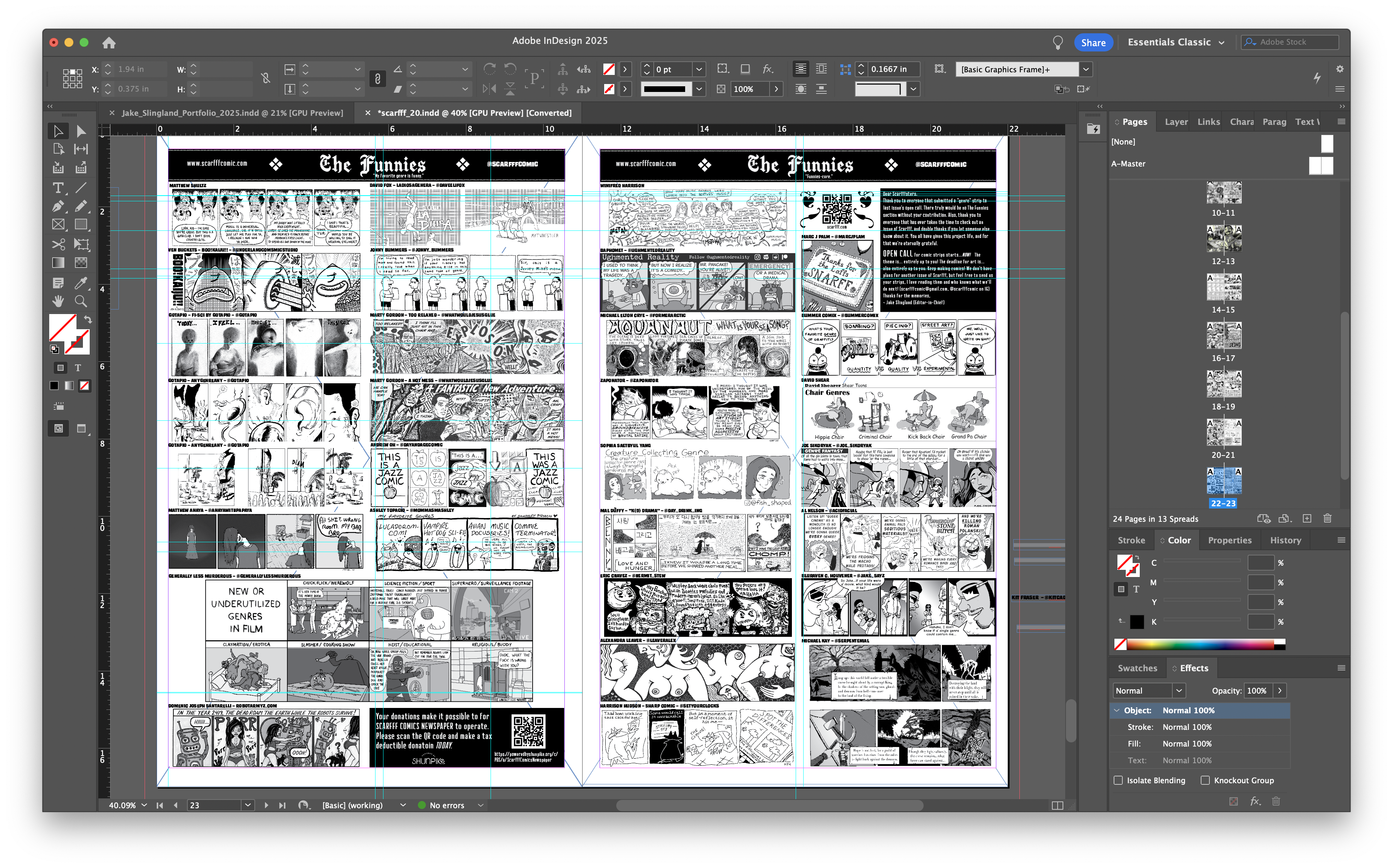
It was decided early on that this section worked best when it was as densely packed with comic strips as possible. A simple grid was employed to maximize content while maintaining legibility.
Typography
Expression & Utility
The Funnies was the only section that had a consistent typographic voice from issue to issue. In every other section, all lettering was up to the artist tasked with creating that page, or spread. An old-school gothic script, hand-lettered and centered in the section headers, was accented by two Blambot fonts that do a great job of being clean and legible, while still communicating “comics.”
Production
Layout to Printing
Layout, editing, and pre-press for every issue — files prepped and delivered to the printer. No deadlines missed.
Adobe InDesign window showing the Issue 20 Funnies spread laid out on a column grid with guides.
InDesign — The Funnies spread, Issue 20
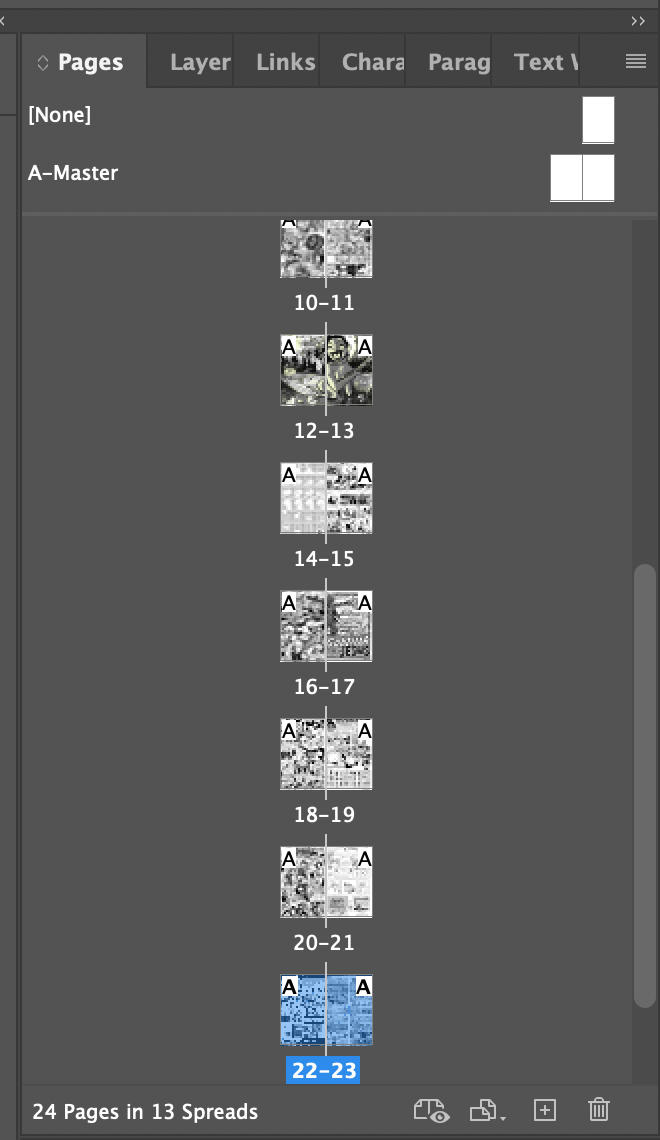
InDesign Pages panel listing the Issue 20 spreads, 24 pages in 13 spreads.
InDesign — Pages panel · 24 pages
InDesign
Layout & print prep
Photoshop
Image correction
Pre-press
File prep for the printer
Table of Contents — Issue 20
Photo of the first issue being printed at Pacific Publishing, in Seattle, WA.
02
Website — UI / UX

Scarfff, Online

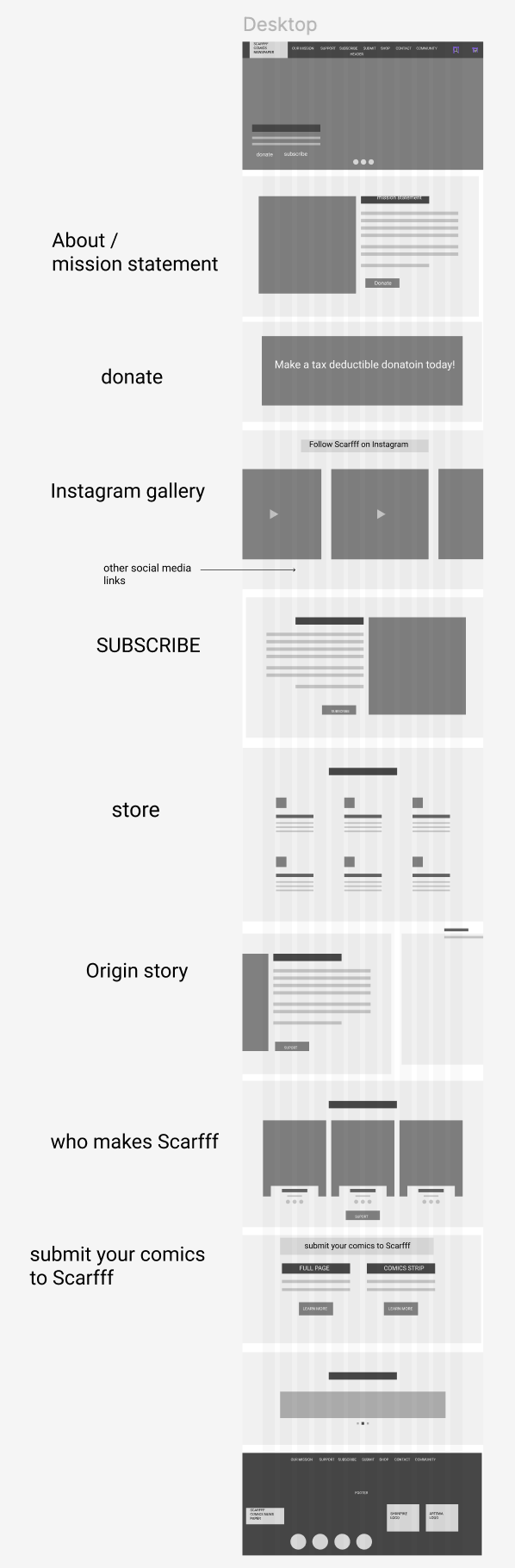
Scarfff Comics Newspaper required a legit website — a portal through which the story of Scarfff could be communicated to potential donors and grant-awarding bodies, while also being a resource for fans and potential contributors. The site needed to confer confidence, tell the story and translate the vibe of the project. To achieve this, a ‘jobs to be done’ list was created to ensure the site's utility to users; a design system and wireframe, including color palette and type scales, were created in Figma, and the final live site was built using Webflow. Every image of the paper was from a scan of the physical printed copies so that its analog texture would ring clear.

Visit scarfff.com — archived at Issue 20 ↗
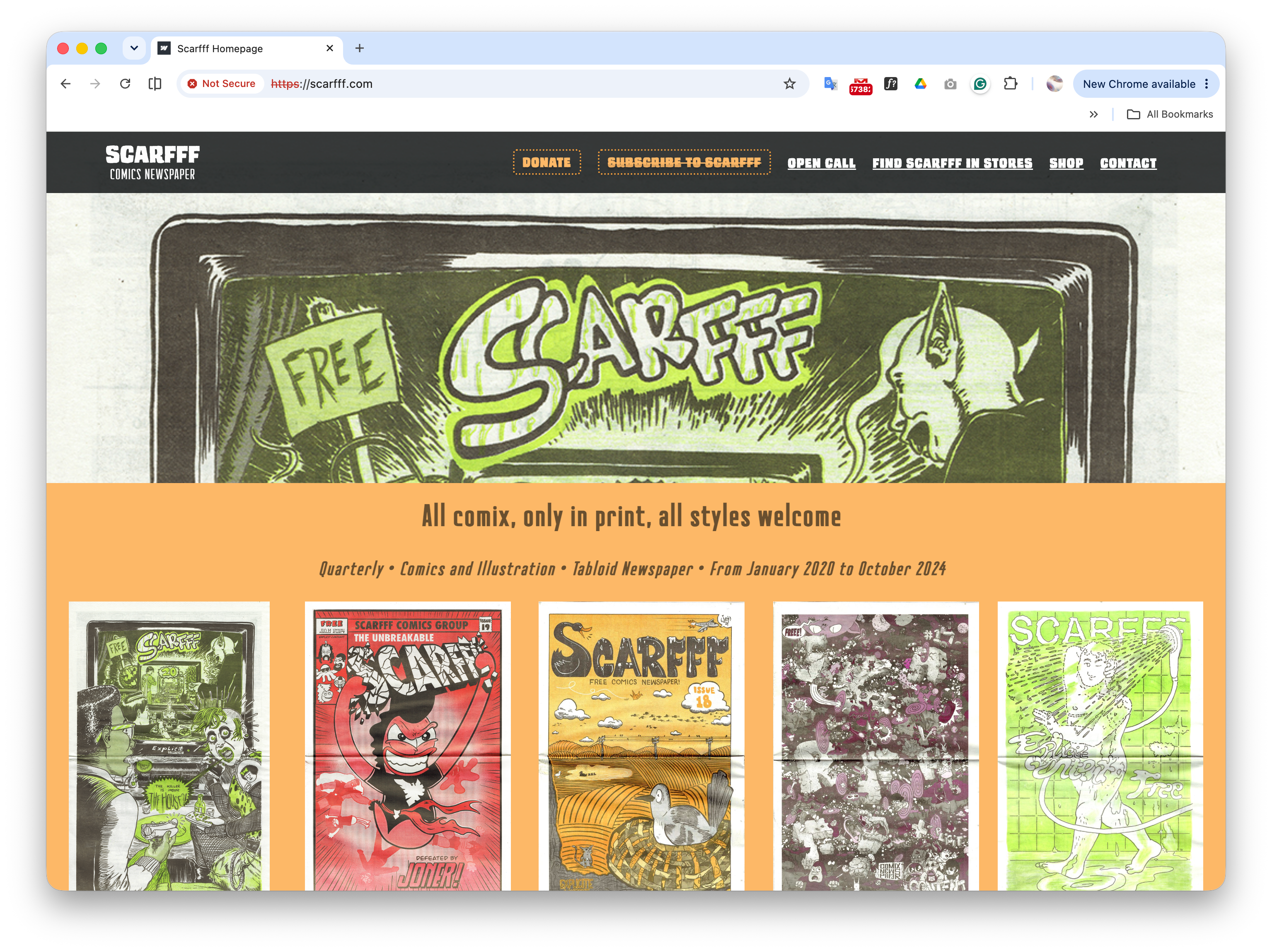
The Scarfff Comics Newspaper homepage open in a desktop browser window, showing the header navigation, hero cover art and a row of issue covers.
Desktop — live site — homepage
Desktop — live site — full height
Mobile — live site — full height
Figma
Layout & UX planning, design system
Photoshop
Graphic prep & assets
Webflow
Final responsive build
Figma — layout & design system
Figma wireframe of the Scarfff desktop homepage, labeled top to bottom: about and mission statement, donate, Instagram gallery, subscribe, store, origin story, who makes Scarfff, submit your comics, and footer.
Wireframe — desktop
03
Editorial

Expression, Communication

The editorial process for Scarfff primarily consisted of building a roster of contributing cartoonists for each issue. Every theme for the twenty-issue run of the paper had been preselected at the beginning of the project, so communicating timelines and formatting to artists, as well as deciding the order in which contributors appeared in the paper were some of the key choices being made from issue to issue.

Cover art & contributor illustration across the run
Art Direction

Visions of Community

The challenge of creating something like Scarfff was finding the right balance between the chaotic energy of underground comics and the requirements and mental models associated with newsprint media.

Editorial
Communication is Key
Each issue featured the core founding cartoonists and an array of guest contributors. Everyone was encouraged to be as creative as possible, with the only restrictions being Scarfff’s loose contributor guidelines and the theme of the particular issue. Communication with artists and outreach to new potential contributors became essential as the project grew in scope. Scarfff, being a scrappy non-profit publication, required building a community as much as creating a printed publication.
Founding Artist & Contributor
Cartooning Love
I contributed content to every issue of Scarfff, usually two full pages, often one of which was the table of contents, all of which I hand-lettered, drew, and inked.
Voice
Aesthetic of Freedom
It was part of the concept of the paper from its inception to forgo many of the more traditional print conventions, in favor of allowing for more creativity, so the title and masthead for Scarfff were always uniquely hand-lettered by whoever was tasked with creating the cover or table of contents for any given issue. Scarfff did have one consistent element — “Scarfff Green”; once a year it would get rolled out as the spot color for an issue, which meant it was the only color ink besides black in the issue.
04
Publishing · Grants · Distribution

Running an Arts Publication

Scarfff was free for readers and ad-free from the start, so being scrappy with all aspects of the project was a must. It was initially paid for through a Kickstarter and by splitting costs among the contributors, then by running a Patreon, which eventually led to becoming fiscally sponsored, then to applying for and receiving arts grants, tabling at comics festivals and other community events, and even creating and running comics and zine-making camps for kids at local charter schools. All shipping and distribution was handled by founders and contributors, with the help and support of comic shops and various retailers that connections were made with over the course of the project.

Funding
Fiscal Sponsorship & Grants
Fiscal sponsorship through Shunpike opened the door to competitive funding: an ArtsWA "RENEW" grant backed by NEA funds, and later a City of Seattle smART Ventures grant. These grants allowed the project to grow substantially, moving from a purely zine-style, D.I.Y. co-operative model to a community arts publication approach. Arts funding and crowdfunding management were challenging, but allowed for the publication to grow as the project moved forward.
Connecting
Subscriptions & Connections
Social media let Scarfff expand well beyond the local Seattle scene, and managing subscriptions through Patreon let Scarfff connect directly with readers worldwide. Everything was being done to make more opportunities for underground cartoonists and put newsprint comics back in readers' hands. Sustaining these pipelines required constant maintenance and content creation, including bonus comics and zines for patrons, and daily posts and reels on Instagram.
Getting it out there
Printing & Distribution
About 3,000 copies of each issue were printed. About 10% of the run went to Patreon subscribers; the rest were distributed to more than 23 retailers and non-profit arts spaces across multiple countries, and at events like comics and arts festivals. Scarfff tabled at Short Run Comix Festival and Hot Off the Press Fest in Seattle three years in a row, Chicago Alternative Comics Expo (CAKE) two years, and Small Press Expo (SPX) in Bethesda, MD.
smART Ventures grant — announced to readers
Print distribution — stacks bound for retail
23+ stores
Free to readers and retailers.
Fantagraphics Seattle Push/Pull Seattle Phoenix Comics Seattle Floating World Portland Silver Sprocket San Francisco Comix Experience San Francisco Mission Comics San Francisco Quimby's Chicago Desert Island Brooklyn Atomic Books Baltimore Partners & Son Philadelphia Strange Adventures Halifax Aloha Got Soul Honolulu + more →
05
Print Run — 2020 to 2024

Five Years, Concept to Reality

The first issue of Scarfff was printed in January of 2020 with five contributors and distribution to a handful of stores in Seattle. Over five years, it grew into a grant-funded publication with a global subscriber base and a table at SPX, one of the most prominent small press festivals in the United States.

Jan 2020
Issue 1 printed & distributedThe first paper hits the street.
May 2020
Patreon launchesDirect subscriptions begin — readers around the world.
Nov 2021
Short Run Comix FestivalFirst of three years tabling in Seattle.
Feb 2022
Fiscal sponsorship — ShunpikeThe structure that made grant funding possible.
Jun 2022
"RENEW" grant — ArtsWA + NEAWashington State Arts Commission & National Endowment funds.
Aug 2023
smART Ventures grantCity of Seattle Office of Arts & Culture.
Oct 2024
Issue 20 — the final issueTwenty issues. Five years. A complete run.